Work · Ethical Lens

Ethical
Lens

From Clicks to Conscious Choices — the plug-in that makes ethical shopping effortless.

UX Research Product Strategy Competitive Analysis UI Design Usability Testing Business Thinking
Project Type
Browser Plugin — UX Case Study
Role
Solo — Research, Strategy, Design, Testing
Timeline
2025
Tools
Figma · Chrome Extension APIs
01
Origin

Overview & Personal Interest

I've always loved fashion as a form of self-expression. But as I learned more about fast and affordable fashion, I became aware of its hidden costs — environmental damage and unethical mass production.

Online shopping makes it easier than ever to buy more without thinking twice. I don't believe convenience and sustainability have to be opposites. Ethical Lens was born from that tension: my love for fashion and my desire to make conscious choices easier through design.

This project is also a product thinking exercise. I didn't just want to design a pretty interface — I wanted to understand whether the problem was real, who it was really for, and whether a viable solution was possible.

2
Rounds of user interviews & testing
6+
Competitors and indirect alternatives mapped
3
Prototype fidelity phases — lo → mid → hi
02
Problem Space

The Big Idea

Before looking for a solution, I mapped real shopping behavior. Starting from a very specific story — someone trying to buy dog deodorant online — I traced a typical purchase journey to find where frustration, trust, and decision-making actually live.

What emerged wasn't a problem with price or delivery. It was information asymmetry: users suspected brands were hiding something, but had no easy way to verify it while shopping.

"In a world where buying takes just a click, the real cost is often hidden — paid by people and the planet."

With that insight in mind, two How Might We questions guided everything that followed:

How might we help online shoppers make ethical choices effortlessly so that everyday purchases have a lower environmental impact?

Research supports the opportunity: studies show sustainability labeling at the point of purchase can directly move consumer behavior. → Read the research article ↗

03
Strategy ★

The Solution

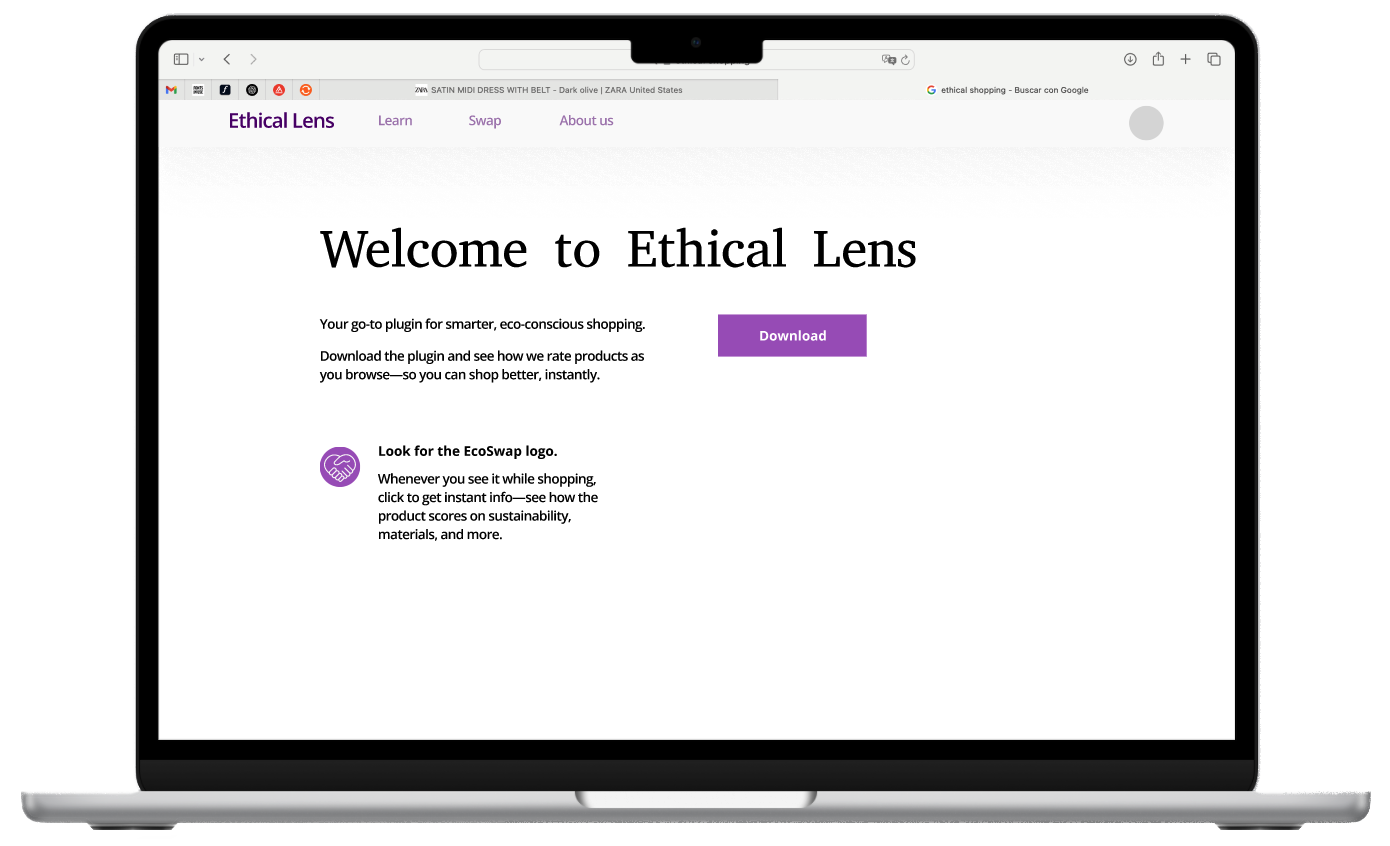
After the competitive analysis (see below), one constraint became the design north star: the solution had to meet users inside their existing shopping flow — without requiring any behavior change.

Strategic Decision
"What if every product online came with a visible conscience?" — A browser plugin is the only format that requires zero behavior change and surfaces information exactly when purchase decisions are being made.

I ruled out other formats before settling on a plugin. This was a deliberate product decision, not a design default:

✕ Ruled Out
App
Requires users to open a separate tool before or after shopping. Demands behavior change — users forget, skip, or abandon it entirely.
✕ Ruled Out
Website
A destination you have to remember to visit. No integration with the moment of purchase. Same friction problem as an app.
✓ Chosen
Browser Plugin
Zero behavior change. Works inside the existing shopping flow. Surfaces information exactly when decisions are being made — across all retailers.

Before ideating, I mapped the existing landscape to pressure-test the opportunity. I looked at direct competitors and indirect alternatives.

Direct
Good On You
What I learned
Large ethical brand library — but destroys the shopping flow. Users must leave the store to check a brand's rating.
Direct
DoneGood
What I learned
Curated ethical marketplace — a separate destination, not integrated into existing shopping habits.
Indirect
Google Search
What I learned
Users manually search "Is [brand] ethical?" Very few take this extra step — it should be effortless.
Indirect
Reddit / TikTok
What I learned
Trusted peer advice — but slow, unsearchable, and unavailable at the point of purchase.

Opportunity Gap: No existing tool meets users inside their shopping flow. All require users to leave their browsing session, dig through external sites, or trust unclear and inconsistent rating systems.

04
Research

Audience Research & Persona

I conducted two rounds of interviews — intentionally separate. The first was about understanding shopping behavior in general. The second was focused specifically on ethical shopping habits, trust, and real decision-making. I wanted to validate whether the problem was real before designing anything.

Goal: Understand motivations, not test solutions.

  • What frustrates people when they can't find products in physical stores?
  • What makes an online store feel like the best place to shop?
  • How do discounts or promotions influence purchasing decisions?
  • What role does convenience vs. trust play when choosing where to buy?

Key finding: The pain point wasn't price or delivery speed. It was information asymmetry — users suspected brands were hiding something but had no easy way to verify it while shopping.
Goal: Validate whether this problem is real and worth solving.

Key findings:

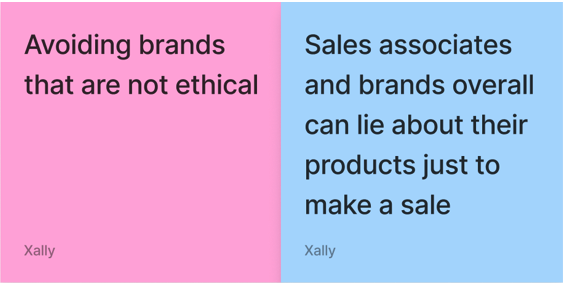
  • Many users don't trust brands that self-label as "ethical" without third-party evidence
  • Users would pay more — but only if the value was transparent and immediate
  • Finding ethical alternatives requires too much effort; most abandon the intent
  • For many users, convenience wins. Ethical intent doesn't survive friction.

Critical insight: This isn't a universal problem. It's a real one — but only for a specific type of shopper. Rather than designing for everyone, I needed to find exactly who this was for.

Meet Juliana

Among all participants, Juliana emerged as the clearest signal — not just the most enthusiastic user, but someone who was already doing this manually. She validated that a motivated niche exists and is underserved.

Juliana Martinez
25 · NYC · Marketing Coordinator · $55K–$85K
Background

Juliana has always cared about social and environmental issues. She follows sustainability creators on TikTok and Instagram, signs petitions, and tries to reduce waste in her daily life.

Goals
  • Make purchases aligned with her values
  • Avoid supporting unethical labor or environmental harm
  • Discover ethical alternatives without sacrificing quality
Pain Points
  • Feels manipulated by greenwashing
  • Doesn't trust vague marketing claims
  • Guilty after buying from questionable brands

"I want to know instantly whether a brand aligns with my values — without having to open ten tabs or rely on vague marketing claims."

Why Juliana is the signal

Juliana wasn't just the most enthusiastic participant — she was already doing a version of this manually. Google searches, Reddit threads, a mental blocklist of brands to avoid. She had the intent and the habit. She just lacked the tool.

Recognizing her as a strategic signal — not just a persona — reframed the entire product. Ethical Lens isn't for everyone who shops online. It's for people like Julia: proactive, values-driven, already motivated, just underserved.

05
Design

Design Process

From hand-sketched explorations to a tested Figma prototype — three phases, each one informed by what the previous phase revealed.
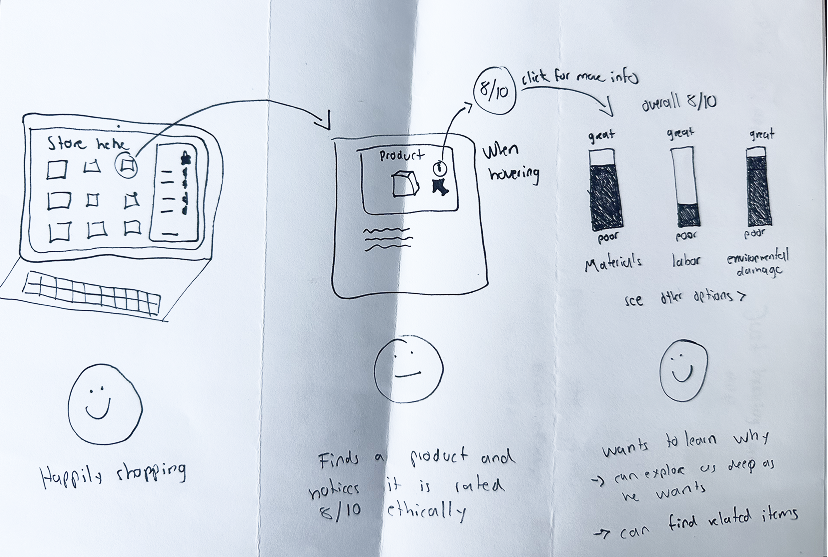
01
Low-Fidelity
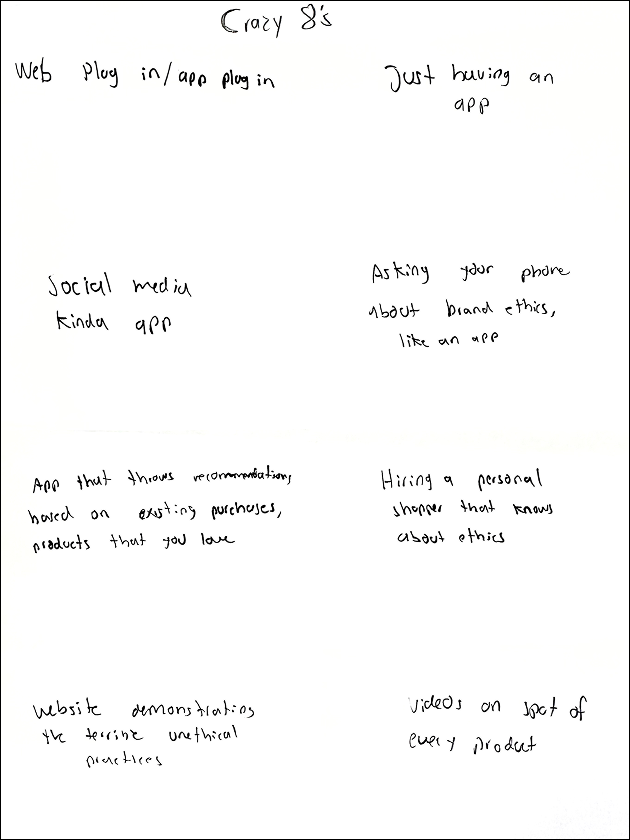
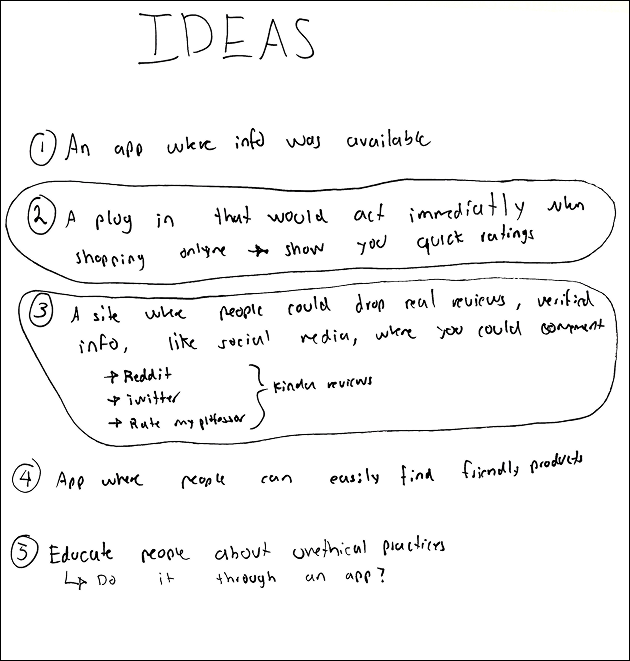
Hand-drawn Crazy 8s and wireframes. Focused on layout logic and user flow — not aesthetics. Explored multiple formats before committing to the plugin.
02
Medium-Fidelity
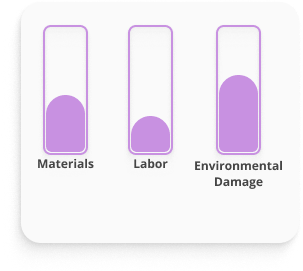
Figma wireframes with structure and basic UI. Tested with real users for a first round of feedback. Rating system caused confusion — needed rethinking.
[
03
High-Fidelity
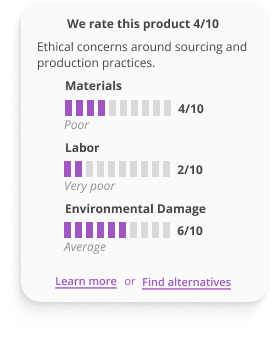
Polished UI after testing insights. Simplified rating system, improved consistency across states, added ethical alternatives flow.

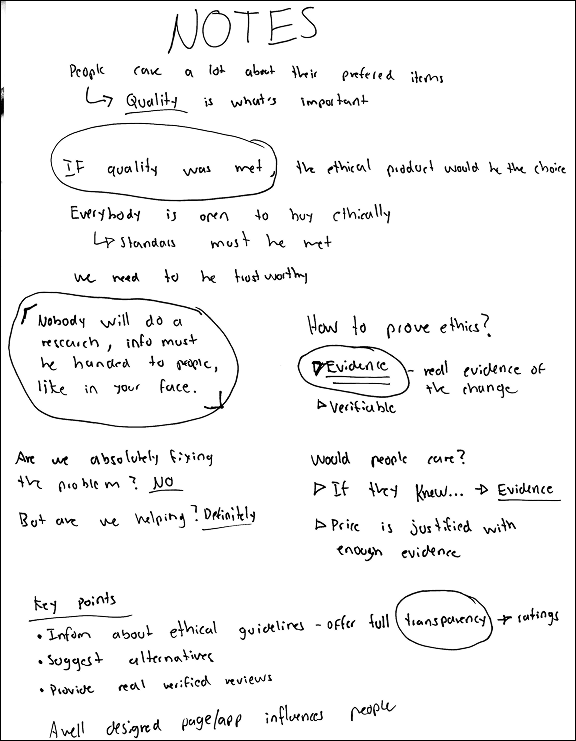
Ideation Sketches

06
Testing

Testing & Feedback

I tested early and often — not to validate assumptions, but to challenge them. Two rounds of testing revealed what worked, what didn't, and confirmed who the product was truly for.
Round 1 Concept & Usability Validation 5 participants · May 2025
What I tested
Core concept viability and initial prototype usability. Was the rating system clear? Did the plugin feel natural inside a shopping session?
Key findings
Rating system caused confusion — too many categories, unclear scores. Users wanted more cohesive visual language across states. Some participants didn't prioritize ethical shopping at all.
Conclusion
Concept resonates for the right users. UI needs a redesign. The audience clarity question (who is this really for?) becomes more urgent.
Round 2 Refined UI Validation 5 participants · September 2025
What I tested
The redesigned rating system, improved navigation, and overall cohesiveness. Did the UI hold up? Was it truly embedded in the shopping experience?
Key findings
Users found the plugin easier to interpret, more intuitive to navigate, and naturally embedded. Julia-type participants were especially enthusiastic — they found immediate personal relevance.
Conclusion
The UI works. If launched today, the interface holds up. The remaining question is market size — not product quality.
07
Deliverables

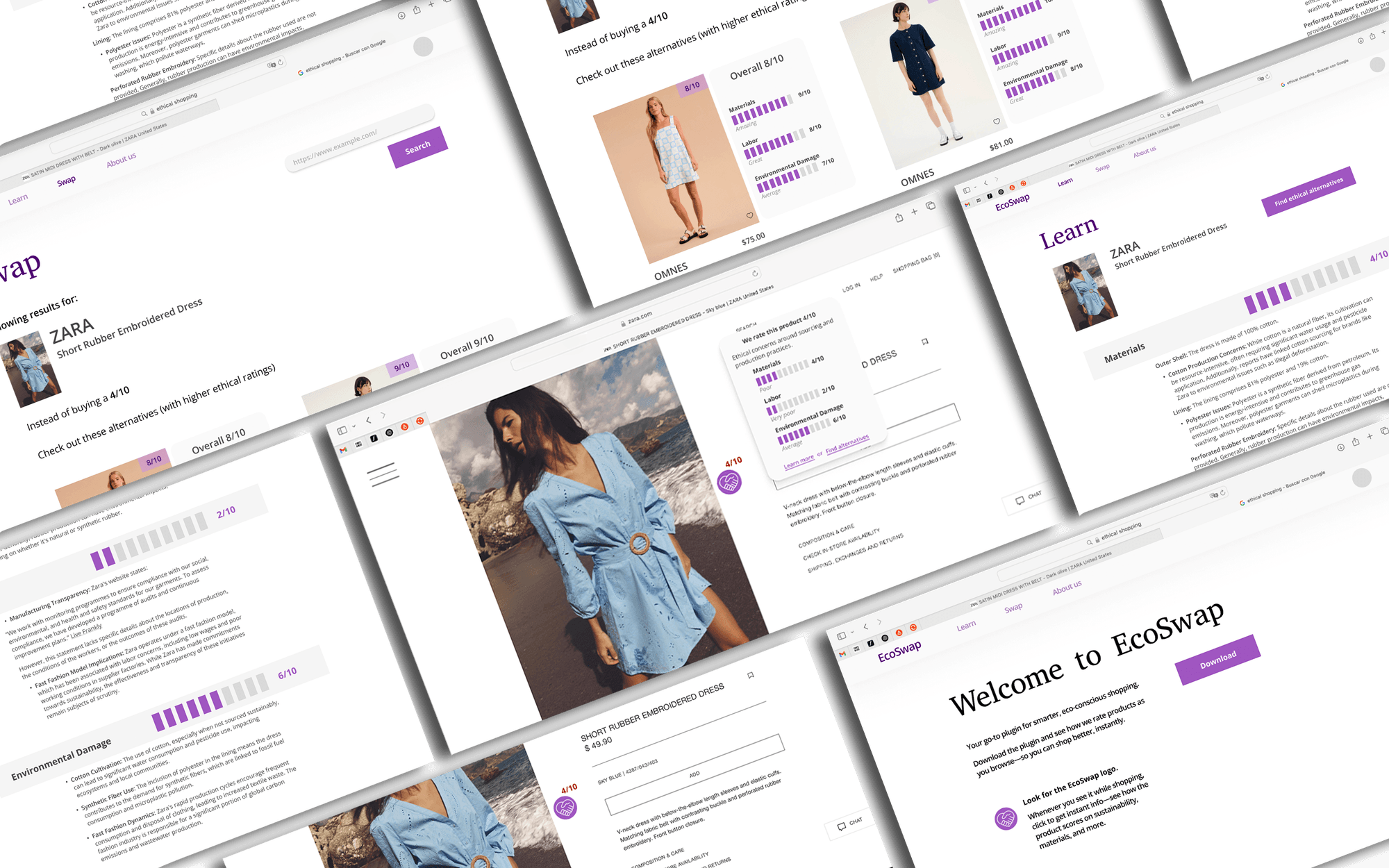
Final Prototype

Usability Test
Juliana
Your Task:
You're shopping online and want to check whether a brand aligns with your values. Use Ethical Lens to find an ethical alternative.

Juliana's Task Flow

1
Browse
Juliana shops on any retailer site
2
Icon Appears
Ethical Lens icon surfaces automatically
3
Check Ratings
Clicks icon — reads labor, climate, welfare scores
4
Learn More
Taps to see in-depth brand information
5
Alternatives
Explores ethical alternatives at similar price
6
Purchase ✓
Completes ethical purchase — same session
🔗
Interactive Prototype
Full clickable hi-fi prototype in Figma. Explore the complete plugin experience from browse to ethical purchase.
Open Prototype in Figma ↗
📄
Full Case Study PDF
Complete slide deck including all research, process documentation, and business considerations.
Download PDF Deck ↗
Design Component 2

Demo Video

08
Strategy

Business Considerations

Validating that a product solves a problem isn't the same as validating that it's worth building. Once I confirmed the interface held up, I stepped back and asked the harder question: is there a viable business here?

💰
Monetization
Three plausible models: affiliate/referral commissions (earns when users click through to ethical alternatives), freemium subscription (basic ratings free, deep brand audits paid), or B2B licensing to retailers who want to display verified ethical credentials. Key tension: the chosen model must protect the credibility of the ratings.
🎯
Market Size
60–70% of Gen Z say brand ethics matter in purchases. Comparable tools (Good On You, DoneGood) have built real user bases with minimal marketing spend — demand is real. The question is the gap between "it matters to me" and "I actively research it" — that motivated-but-underserved group is where Ethical Lens lives.
📣
Acquisition
Julia-type users already congregate in specific places: r/sustainablefashion, r/ethicalconsumer, ethical fashion creators on TikTok and YouTube, and Chrome Web Store organic search. A freemium model with niche community word-of-mouth is the natural acquisition wedge.
🔒
Defensibility
Not defensible yet — and that's honest. Two paths worth exploring: community-verified data (Waze model — users contribute sourcing info, creating a proprietary dataset) or exclusive certification partnerships with Fair Trade, B Corp, Rainforest Alliance, and similar bodies.
09
Reflection

What I Concluded

Honest Verdict
This is a real product, for a real niche — but not for everyone. And that's okay. A focused product for a motivated niche is a stronger starting point than a vague product for everyone.
01
The format choice is the product decision.
Choosing a browser plugin over an app or website wasn't a design preference — it was a strategic call. The right format makes the solution self-evident to the user. Everything else follows from that constraint.
02
Slow down before you build.
Going back for a second round of research instead of rushing to design revealed the most important truth: this isn't a universal problem. Knowing that before investing in a full build is worth everything.
03
Intellectual honesty is a product skill.
Concluding that this is a niche product — not a mass-market one — took discipline. Most projects try to look like billion-dollar opportunities. Accurate beats optimistic when the goal is to actually ship something that works.
  • Run screener surveys to recruit specifically for Julia-type users and size the niche
  • Validate willingness-to-pay and price sensitivity threshold within the segment
  • Build a development-ready spec with a clear go-to-market strategy targeting values-driven communities
  • Explore a fundamentally different product angle: instead of informing ethical shoppers, how do you create them?