Work · Valora
UX Design Couples · FinTech Mobile · iOS 0 → 1

Valora

From financial ambiguity and quiet tension →
shared clarity, aligned goals, and mutual motivation.

Role
UX Designer + Product Strategist
Timeline
10 weeks
Tools
Figma · FigJam · Notion
Platform
iOS Mobile App
Type
Academic Project — Academy of Art University
Valora app screens
01
Overview

Personal Interest

I've seen couples slowly fall apart over money — not because they didn't love each other, but because they felt unsupported in their personal goals. When finances aren't transparent, it's easy to start believing your partner is holding you back instead of building with you.

I want to help prevent that. I believe that when couples have a clear, neutral system to align on both individual and shared goals, money becomes something that strengthens the relationship instead of quietly creating distance.

"Money should build the relationship, not quietly erode it."

69%
of couples say money is the leading source of conflict in their relationship
3 in 5
dual-income couples operate on separate financial assumptions without realizing it
more likely to report relationship satisfaction when finances are discussed collaboratively
02
Strategy

The Big Idea

Valora is not a budgeting app. It doesn't track every transaction or optimize your taxes. It does one thing: it gives couples a shared, neutral space to see their finances clearly and align on both personal and long-term goals.

Instead of money being a source of quiet tension, it becomes something couples navigate together — a tool for motivation, clarity, and a stronger relationship. The core question Valora answers is simply: "Are we on track?"

HMW How might we help dual-income couples visualize their shared finances so that they can align around common and individual goals?

Financial Transparency and Marital Satisfaction
Nova Southeastern University — Couples who jointly engage in financial partnership activities experience a higher level of relationship satisfaction.
[ Article link ↗ ]

When couples fight about money, what do they fight about?
NCBI — Money disagreement is the most destructive type of conflict in relationships, more damaging over time than any other category of dispute.
[ Article link ↗ ]

Collaborative Money Conversations
Nina Collavo, Cornell University — Talking about money openly builds trust, reduces financial anxiety, and strengthens long-term commitment when done collaboratively.
[ Article link ↗ ]

03
Research

Audience Research & Persona

Research confirmed that the target audience for Valora is not defined by income level, relationship length, or financial literacy. It's defined by one shared condition: they are building a life together, but operating on separate financial assumptions.

The product has to speak to the partner who feels uninformed — and reassure the partner who fears being surveilled. I identified three recurring user types across my research.

👤
The Uninformed Partner
Earns income, has goals, but feels excluded from the shared financial picture. Not irresponsible — just not in the loop. Valora gives them visibility without requiring a difficult conversation.
The Overscheduled Manager
Handles most household finances and feels unsupported. Doesn't want to be the sole bearer of financial awareness. Valora creates a shared system that removes the burden from one person.
💡
The Avoider
Knows things are probably fine but can't shake the low-grade anxiety. Never initiates money conversations. Valora replaces the dreaded conversation with a low-stakes weekly ritual.
Maya Ortiz [ Photo: Maya Ortiz ]
Maya Ortiz
29 · UX Researcher · Austin, TX · Living with partner 2 years
Goals & Motivations
  • Feel like an equal financial partner
  • Save toward shared milestones without guessing
  • Have money conversations that don't feel like confrontations
  • Know her personal goals are visible and respected
Pain Points
  • Doesn't know if their combined spending supports shared goals
  • Avoids money talks to prevent conflict
  • Feels like the "uninformed" partner — not due to lack of interest
  • Existing apps feel like surveillance, not partnership
Background

Maya earns a solid income and has her own savings goals — a trip to Portugal, a down payment someday. Her partner Javier handles most of the household expenses but rarely talks about money. She trusts him, but she's started to feel financially invisible in their shared life. She doesn't want a budget app. She wants to know: are we on track?

"I don't want to control his money. I just want to know if we're actually getting anywhere together."

— Maya Ortiz, 29, Austin TX
Values · Motivations · Interests
  • Partnership — building together, not in parallel
  • Shared progress and feeling financially seen
  • Travel, home design, career growth

I interviewed Marco and Sophie (31 & 28), a tech couple based in San Francisco who have been together 2 years and living together for 1. Interview conducted March 10, 2026, via in-person session.

  • Financial conversations are often avoided until a triggering event forces them. The dominant emotion around money discussions is anxiety rather than conflict.
  • Transparency is desired, but not constant monitoring. Both partners prefer high-level signals about financial health rather than reviewing every transaction together.
  • Personal financial goals exist but are rarely shared or aligned. Partners often assume alignment without explicitly discussing priorities.
  • Existing tools don't support shared financial alignment. Most focus on expense tracking or budgeting, leaving a gap for tools centered on shared progress and goals.
Direct Competitor
Monarch
What it does well
Shared household finance dashboard. Brings separate and joint accounts into one view.
Gap
Feels more like a budgeting app than a goal-alignment tool. No emotional layer around shared progress or couple motivation.
Adjacent Competitor
Splitwise
What it does well
Excellent for splitting expenses in real-time. Easy to track who owes what.
Gap
Transactional by design — focused on the present moment, not long-term goals. No vision for what couples are saving toward together.
The Opportunity
Valora
What we do differently
Goal-first rather than budget-first. Shows shared and individual progress with weekly check-ins. Designed to reduce financial anxiety — not just track spending.
04
Process

Design Process

I started by exploring three conceptual directions: a shared dashboard, a goal-first feed, and a weekly ritual app. The final design combined all three — a goal-first dashboard anchored by a weekly check-in flow.

Every design decision had to pass one filter: does this feel safe, or does this feel threatening? Money carries psychological weight, and the interface itself is a form of communication between partners.
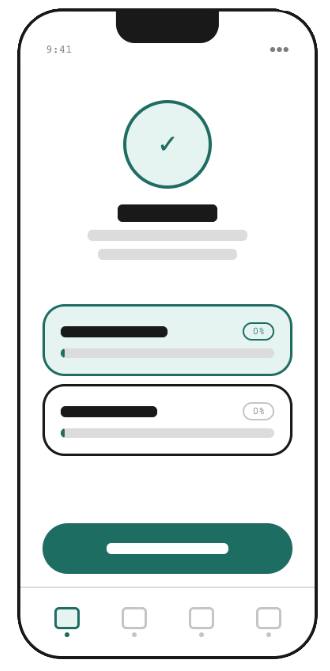
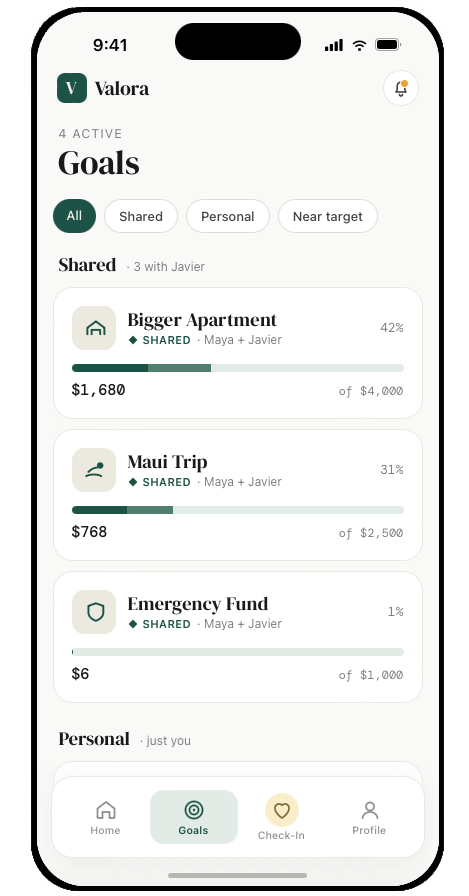
Lo-fi wireframe — Active Goals screen
01
Low Fidelity — Active Goals
Started by creating low-fidelity wireframes to determine the layout and the most important aspects of the app. The core question at this stage: what does "on track" look like at a glance?
Focused on establishing the structure of the Goals screen — how to surface both personal and shared goals, progress indicators, and partner contributions without overwhelming the user.
Hi-fi — Active Goals screen
02
High Fidelity — Active Goals
Once the structure was established, I moved to high fidelity — applying Valora's full design system: deep forest green, warm off-white cards, amber accents for milestones, and DM Serif for headings.
Progress bars animate on load. "Shared" and "Personal" goal tags are visually distinct. Each shared goal shows both partners' contributions inline — Maya's in teal, Javier's in sage.

I defined three core task flows to validate the structure before moving to high-fidelity:

Persona: Maya  ·  Task: Set a shared + one personal savings goal  ·  Outcome: Both goals live on dashboard; partner notified

01
Home Dashboard
Maya opens Valora. No goals yet. Prompt: "Add a goal"
02
Tap '+ New Goal'
CTA tapped. Goal type selector appears.
03
Select Goal Type
Choose Shared or Personal. Maya picks Shared.
04
Name & Set Target
"Bigger Apartment" · $4,000 · June deadline
05
Invite Partner
App sends Javier a link. He accepts. Goal is now shared.
06
Add Personal Goal
Back to goals. "Portugal Trip" · Personal · $2,000
07
Review & Confirm
Maya sees both goals listed. Taps "Start Tracking".
08
Goals Active 🎉
Dashboard shows both goals with live progress bars.

Persona: Maya  ·  Task: Complete the weekly financial alignment check-in  ·  Outcome: Maya aligned; streak updated; note sent to partner

01
Push Notification
Sunday 7 PM: "Your weekly check-in is ready 📊"
02
Check-In Screen
Goal progress, week's spending summary, partner status.
03
Review Progress
Apartment goal 42%. +$310 this week. On track 🟢
04
Choose a Mood
😌 Calm · 🎯 Focused · 😬 Worried · 😤 Frustrated
05
Answer 2 Prompts
"Anything to flag?" + "One thing you're proud of?"
06
Leave a Note
Optional. Maya types "Good week! 🌿" for Javier.
07
See Partner Status
Javier already checked in. Mood: On track 🟢
08
Check-In Done ✓
🔥 3-week streak. Javier notified. Next: Sunday.

Persona: Maya  ·  Task: Check current status of shared and personal goals  ·  Outcome: Maya understands both goal statuses in under 60 seconds

01
Home Dashboard
Summary card: "You're on track 🟢"
02
Tap Shared Goal
Maya taps "Bigger Apartment" card to expand.
03
Goal Detail
42% progress. $1,680 of $4,000. Monthly trend chart.
04
Check Projection
"On track to hit goal by June at current pace."

Valora's visual system had to feel calm, trustworthy, and collaborative — like a financial advisor who's also a friend. Every color, font, and UI element was chosen to reduce anxiety, not trigger it.

  • Primary color: Deep forest green #1B5E4F — signals calm, growth, trust
  • Accent: Warm amber #F5A623 — used only for milestones and CTAs to feel like a reward, not an alert
  • Typography: DM Serif Display (headings) + DM Sans (body) + DM Mono (financial figures)
  • Progress indicators: Green bars and donut charts — animate on load to feel alive and dynamic
  • Tags: "Shared" in teal, "Personal" in amber — always visible so both partners know what belongs to whom
  • Voice: Neutral, encouraging, never alarmist. "You're on track" instead of "You've spent X%"
05
Testing

Testing & Feedback

I ran think-aloud sessions with 3 couples (6 people total) using hi-fi prototypes. Participants were asked to complete all three core task flows while speaking their thoughts aloud. The most significant insight wasn't about usability — it was about trust.

Method Think-Aloud Protocol
Participants 3 couples · 6 people
Date March 2026
Location San Francisco, CA
01
Unspoken assumptions surfaced immediately
Every couple had financial assumptions they had never verbalized. Goals, timelines, and spending norms were treated as shared when they were only assumed. None of the couples had a consistent mechanism to surface these gaps.
Design response: The Goals screen surfaces both partners' individual goals side-by-side — making assumptions visible without a conversation.
02
Avoidance is about timing, not willingness
All three couples mentioned specific financial topics they actively avoid — most commonly to prevent revisiting an argument, or feeling unsure whether it's the right time to bring it up. The problem isn't that people don't want to talk about money; it's that there's never a "right moment."
Design response: The weekly Sunday check-in creates a low-stakes, pre-agreed ritual that removes the friction of choosing when to bring it up.
03
Privacy framing needed reinforcement
Sofia asked whether the app would surface individual spending. This concern stopped her flow entirely. The privacy framing — goals visible, not transactions — was in the product but not prominent enough during onboarding.
Design response: Added explicit privacy messaging to onboarding. "We show goals, not transactions." This became a founding promise of the app.
  • Weekly check-in completion rate — % of couples who complete both partners' check-ins within the same week
  • Goal setup conversion — % of new users who set at least one shared goal within their first session
  • Partner invite acceptance rate — % of partner invites sent that result in the second partner joining
  • Check-in streak retention — average streak length; % of couples maintaining 4+ consecutive weeks
  • Privacy concern drop-off — % of users who exit during onboarding at the data permissions screen (post privacy messaging update)
  • 7-day return rate — % of users who return to the app within 7 days of first use
06
Deliverables

Final Deliverables

Two deliverables: a fully interactive Figma prototype covering all three core task flows, and a full case study PDF documenting the complete DEFINE / DISCOVER / DESIGN / DEPLOY process.

📱
Interactive Prototype
Full Figma prototype covering goal setup (shared & individual), weekly check-in flow, and goal progress dashboard. Each flow begins with a Task Title Card.
01 Goal Setup — Shared & Individual
02 Weekly Check-In / Alignment Moment
03 Goal Progress Dashboard
View Prototype ↗
📄
Full Case Study PDF
Complete presentation deck documenting every phase of the design process — problem definition, research, personas, task flows, design decisions, testing results, and next steps.
Download PDF ↗
Design Component 2

Demo Video

A short walkthrough of the Valora prototype in action — showing the full experience from home dashboard to weekly check-in, looping automatically.

07
Reflection

What I Learned

01
Designing for emotional states is harder than designing for tasks.
Money carries deep psychological weight — every design decision had to pass through the filter of "does this feel safe, or does this feel threatening?" The interface itself is a form of communication between partners. The way information is framed either builds trust or quietly erodes it.
02
The gap isn't in information — it's in conversation.
Couples don't fight about money because they have bad financial habits. They fight because they never established a shared language for their financial life. Valora's real job isn't to show data — it's to create the conditions for a conversation that couples keep postponing.
03
Privacy is a product feature, not a legal disclaimer.
The moment Sofia asked "will this show my spending?" was the most instructive moment of the entire project. The right answer isn't buried in settings — it needs to be in the hero. "We show goals, not transactions" became Valora's founding promise and shaped the entire onboarding.
  • Integrate bank sync via Plaid — remove manual contribution entry to reduce friction
  • Test with 5 additional couples across different relationship stages (newly together, engaged, married with kids)
  • Explore a notification system that celebrates milestones together — not just progress tracking
  • Launch a waitlist and gather early adopter feedback before full development
  • A/B test the weekly check-in prompt language to find the tone that drives the highest completion rate
Conclusion
Designing for emotional states is harder than designing for tasks. Money carries deep psychological weight, every design decision had to pass through the filter of 'does this feel safe, or does this feel threatening?' The biggest insight: the interface itself is a form of communication between partners. The way information is framed either builds trust or quietly erodes it.